

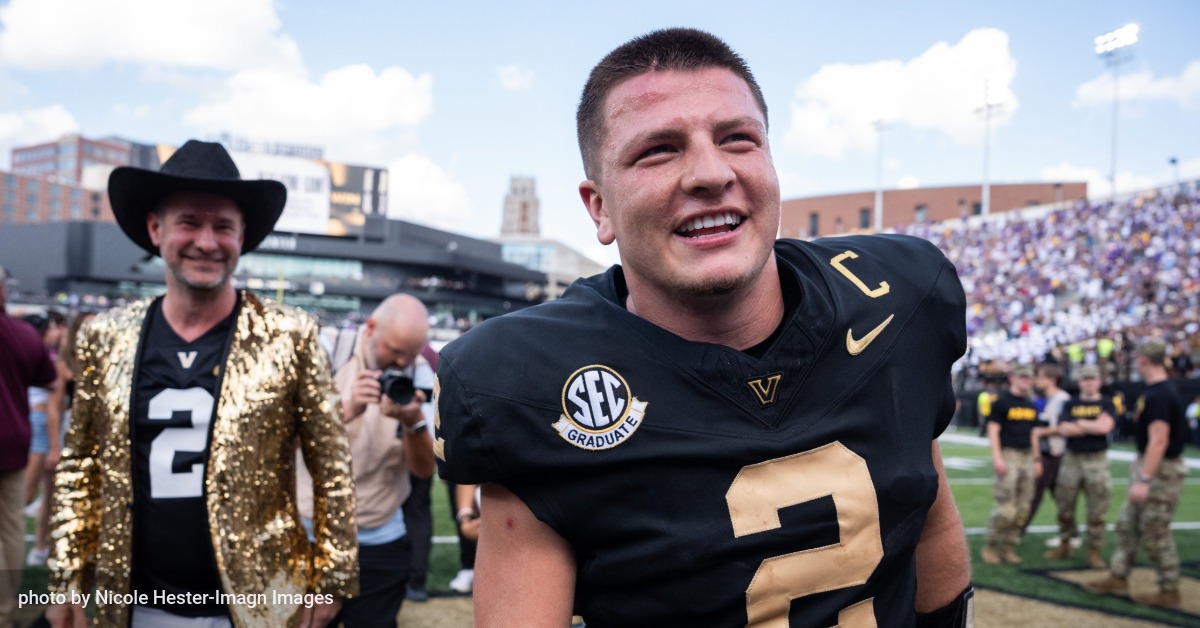
College athletes who began their careers at junior colleges (JUCO) could soon see one of the biggest eligibility shifts in NCAA history. A wave of lawsuits led by Vanderbilt quarterback Diego Pavia is challenging the long-standing rule that counts JUCO seasons toward an athlete’s four years of NCAA eligibility.
If successful, this movement could give thousands of student-athletes additional years to compete at the Division I, II, and III levels, reshaping college sports forever.
How It Started: The Diego Pavia Case
Diego Pavia, now Vanderbilt’s star quarterback and a legitimate Heisman contender, became the face of this eligibility battle after he won a federal injunction in 2024 that allowed him to play a second season at Vanderbilt.
Before joining the Commodores, Pavia played two years at New Mexico Military Institute, a junior college, and then transferred to New Mexico State. Under NCAA rules, those JUCO seasons should have counted toward his four-year eligibility limit. Pavia and his attorney, Ryan Downton, successfully argued that those years unfairly reduced his NCAA career opportunities.
The federal court agreed and granted him temporary eligibility while the case moved forward, setting a major legal precedent.
The Class Action Expansion
In October 2025, Pavia’s legal team announced plans to file an amended complaint that would turn the case into a proposed class action lawsuit representing all NCAA athletes affected by the same rule.
The new complaint will include multiple players from various programs, including:
- Tre Richardson (Vanderbilt)
- Andrew Burnette (Louisiana Tech)
- James Djonkam (Virginia Tech)
- Iman Oates (Oklahoma State)
Their goal is to permanently eliminate the rule that forces JUCO seasons to count against NCAA eligibility.
Why the JUCO Rule Matters
The NCAA’s “five-year clock” gives student-athletes five calendar years to complete four seasons of competition after first enrolling in any college, including junior colleges.
For many JUCO athletes, those early seasons often involve academic recovery or athletic development. By the time they reach a four-year university, their eligibility clock is already halfway over. This rule has long been criticized for limiting opportunities, especially for athletes from lower-income backgrounds who use JUCO programs as stepping stones to reach Division I schools.
If JUCO years no longer count, those athletes could have a full four-year NCAA career after transferring, creating a fairer system that rewards persistence and development.
Legal Impact and What Comes Next
The NCAA appealed Pavia’s injunction, but a federal court refused to review it, leaving the ruling in place for now. In response, the NCAA granted a temporary one-year waiver for certain athletes to play an additional season if they had previous JUCO experience.
That waiver, however, only applies to this season. Pavia’s lawyers are now moving forward with the class action in hopes of making the change nationwide.
At the same time, the NCAA and major conferences are lobbying Congress to pass the SCORE Act, a bill that would give the NCAA limited antitrust protection and prevent further lawsuits related to eligibility.
What It Could Mean for the Future
If the courts side with Pavia and his fellow plaintiffs, the NCAA would need to rewrite its eligibility rules across all divisions. The potential outcomes include:
- JUCO years no longer counting toward the four-year eligibility limit
- More athletes completing full four-year NCAA careers after transferring
- A larger pool of experienced players staying longer in college programs
- Adjustments to scholarship distribution and recruiting strategies
This could also open the door for challenges to other eligibility rules, such as redshirt restrictions and the overall five-year limit.
Bottom Line
The Diego Pavia case has already changed the landscape of college sports for this season, and its next chapter could transform NCAA eligibility permanently.
If JUCO years stop counting against NCAA eligibility, the change would extend athletic careers, create more scholarship opportunities, and make the college sports system more balanced for athletes who take the junior college route.
For now, the case continues in court, but it is clear that the foundation of NCAA eligibility is being tested like never before.


